Umbria, Italy:
The Beautiful
Alternative to Tuscany
Why the most authentic corner of Italy is the one nobody talks about.
Every year, millions of travellers arrive in Florence, rent a car, and follow the same road south through Chianti. The cypress trees are beautiful. The wine is exceptional. The queue for the Uffizi is very, very long. There is, we gently suggest, another way — and it begins the moment you cross south into Umbria.
Tuscany Has Been Discovered. Umbria, Italy Has Not.
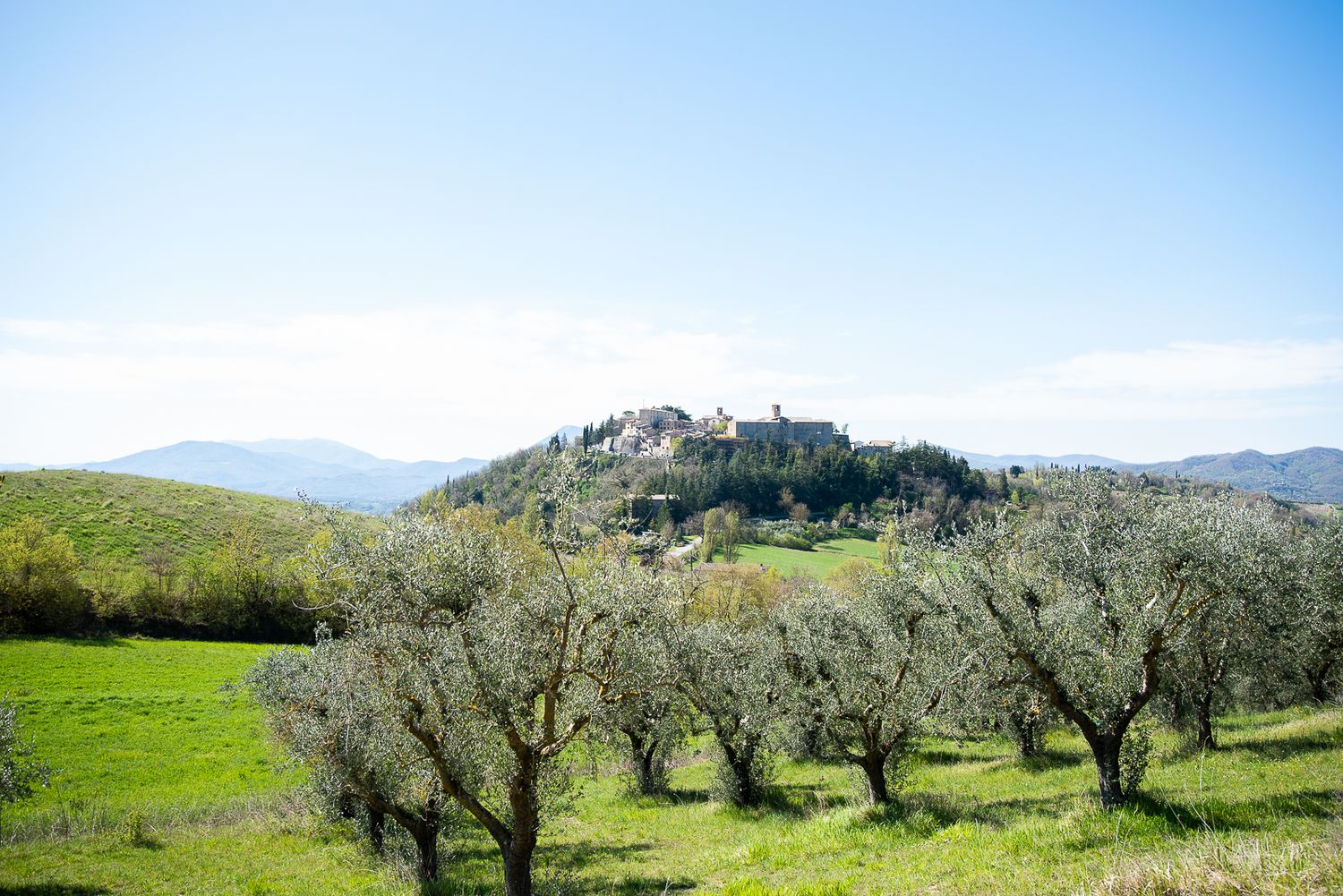
The English call the hills around Lago Trasimeno the "Cashmere Valley." The Italians call Umbria il cuore verde d'Italia — the green heart of Italy. Almost nobody else calls it anything, because almost nobody else has been.This is not because Umbria lacks anything. It lacks nothing. What it has — in extraordinary abundance — is the Italy that Tuscany used to be before the world arrived: medieval hill towns with no coach parks outside the gates, family-run trattorias where the menu changes with the season, landscapes that have not yet been turned into a brand. Stone villages perched on ridges. Truffle hunters moving through oak forest at dawn. Sagrantino vines heavy with fruit in September. Churches full of Renaissance frescoes with no queue, no audio guide, no gift shop.
Umbria sits directly south of Tuscany, sharing its rolling hills and its extraordinary quality of light and its deep, serious obsession with food and wine. What it does not share is the tourist footprint. Where Florence draws four million visitors a year, Perugia — Umbria's capital — draws a fraction of that. Where Siena has become, in parts, a stage set for other people's photographs, Spoleto remains a living town where people go about their lives on a Tuesday morning and tourists, when they appear at all, are a pleasant surprise rather than a feature of the landscape.
Umbria is not undiscovered — Italians have always known about it, and a small number of deeply loyal foreign visitors return year after year with the quiet certainty of people who have found something they are not sure they want to share. But by the standards of modern European travel, it remains remarkably intact. Authentic. Unhurried. Itself.
Slow Travel in Umbria: What It Actually Means
Umbria is a region that rewards patience. The best of it — the truffle markets, the hilltop villages at dusk, the meals that take three hours because nobody is in a hurry to leave — is not found on an itinerary. It is found by those willing to slow down.The ideal way to experience Umbria is from a base: a farmhouse, an agriturismo, a village house that becomes, over the course of a week, something that feels genuinely like home. From there, the region opens up in all directions — a landscape dense with medieval towns, organic farms, craft producers, wine estates and nature reserves, most of them less than an hour's drive apart.
Staying at an agriturismo in Umbria — a working farm that also welcomes guests — is one of the most authentic experiences Italy offers. You sleep in a house that belongs to the land. You eat ingredients grown a few metres from your bedroom. You wake to birdsong and the smell of bread, rather than traffic. The farm's rhythms become your rhythms. And slowly, over the course of a few days, the pace that felt impossibly slow begins to feel exactly right.
At Casale San Cristoforo, our boutique organic agriturismo near Montone in the Alta Valle del Tevere, this is precisely what we offer — for up to four guests at a time, on 14 hectares of land in full conversion to certified organic farming. Fresh bread every morning. Olive oil from our own trees. Eggs from our own hens. And, beyond the gate, the whole of Umbria waiting to be explored.
The Most Beautiful Villages in Umbria, Italy
Umbria holds more officially recognised "most beautiful villages in Italy" than almost any other region — each one distinct, each one lived-in, each one worth far more than the half-hour that most visitors, passing through, give it.The Food and Wine of Umbria, Italy
Umbria takes its food as seriously as any region in Italy — which is to say, with a combination of fierce local pride, deep agricultural knowledge, and a complete refusal to compromise on quality.The black truffle is king here. Found in the oak and hazelnut forests around Norcia, Spoleto and Scheggino, the Umbrian black truffle is considered among the finest in the world — and unlike its white counterpart from Piedmont, it is available at prices that do not require a second mortgage. Shaved over pasta, stirred through scrambled eggs, folded into a simple bruschetta: in Umbria, the truffle is not a luxury. It is a Thursday.
The wine is equally serious. Sagrantino di Montefalco DOCG is made from one of Italy's oldest indigenous grape varieties, cultivated in a small zone around the town of Montefalco and virtually nowhere else on earth. It is tannic, powerful, long-lived — and, tasted in the region where it was born, paired with wild boar or aged pecorino on a cold evening, one of the most compelling red wines you will encounter anywhere in Italy.
Beyond the truffle and the Sagrantino, there is lentils from Castelluccio (grown at altitude on a high plain of extraordinary beauty), pecorino from the shepherds of the Valnerina, porchetta roasted over wood in the old Umbrian way, hand-rolled strangozzi pasta, and bread baked without salt — strange at first, then quietly essential. This is a food culture rooted entirely in the land around it. Nothing comes from far away. Everything comes from here.
Where to Stay in Umbria: Why an Agriturismo Changes Everything
The best way to understand a region is to sleep in it properly — not in a hotel that could be anywhere, but in a place that belongs entirely to where it is.An agriturismo — a working farm that opens its doors to guests — is one of Italy's greatest gifts to the traveller. At its best, it is something quite different from a hotel or a holiday rental: it is an immersion in the rhythms of a particular piece of land, in a particular season, tended by particular people who have chosen it as their life's work.
Casale San Cristoforo, our boutique organic agriturismo near Montone in northern Umbria, offers exactly this. Set on 14 hectares of land in full conversion to certified organic farming, with around 400 olive trees, a vegetable garden, fruit trees and free-roaming hens, it is a place that is genuinely alive — and that alive-ness, we find, transfers to the people who stay here. Guests arrive tired and leave, almost without exception, different. Slower. Fuller. Glad they came.
We welcome up to four guests at a time — two couples, a small family, close friends who have been planning a proper trip for years. It is a small and intimate place, not designed for those who need a pool bar and a concierge, but for those who are ready to be somewhere properly and let it work on them, at its own pace, over the course of a week.
From Casale San Cristoforo, the whole of Umbria is within reach. Montone is eight kilometres. Città di Castello — with its Tuesday market and beautiful Duomo — is nineteen. Perugia, Spello, Bevagna, Montefalco, Lago Trasimeno: all within an hour's drive, each one worth a full day of unhurried exploration.
Come to Umbria. Slow down. Eat well. Drive roads with no other cars on them. Find a village you've never heard of and sit in its main square for an hour. Let the region do what it does to everyone who comes here — which is to make Tuscany feel, just briefly, like the place you go when you don't yet know about Umbria.